
How can we help
If you need any helps, please feel free to contact us.
Call us
9870505880 \ 9870989143
sales@Intence.co.in
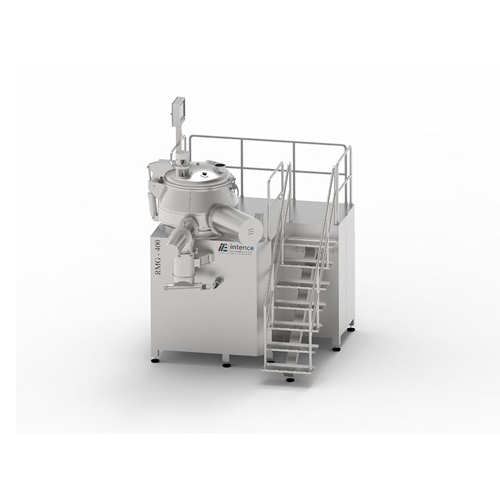
Rapid Mixer Granulator
Technical Specifications
| Parameter | Specification |
|---|---|
| Equipment Type | Rapid Mixer Granulator (RMG) |
| Application | High-Shear Mixing & Wet Granulation |
| Capacity | 1 L to 1800 L (Customizable) |
| Working Capacity | 30%–80% of Bowl Volume |
| Mixing System | Main Impeller with Chopper Assembly |
| Bowl Design | Dead-Space-Free Construction |
| Charging | Vacuum / Gravity Charging |
| Binder Addition | Integrated Binder Spray System |
| Lid Operation | Hydraulic Lid Lifting |
| End Point Detection | Ampere-Based Monitoring |
| Automation | PLC/HMI & SCADA (21 CFR Part 11) |
| Compliance | GMP, ATEX / FLP |
| Pressure Design | 2 Bar / 12 Bar |


Frequently asked questions
The Rapid Mixer Granulator is one of the most important machines used in pharmaceutical manufacturing for efficient mixing and wet granulation. Designed with advanced engineering features, intelligent process control, and hygienic construction, it delivers reliable batch performance while meeting stringent industry standards.
Whether you are looking for scalable production, automation options, or regulatory compliance, our Rapid Mixer Granulator offers flexible configurations to suit a wide range of manufacturing requirements. Below are answers to some of the most frequently asked questions about the equipment.
01. What is the Rapid Mixer Granulator used for?
It is used for rapid mixing and wet granulation of powders to produce uniform granules with consistent quality for pharmaceutical manufacturing.
02. What capacity range is available?
The Rapid Mixer Granulator is available in capacities ranging from 1 L to 1800 L, depending on customer requirements.
03. What optional features are available?
Optional features include SCADA/21 CFR Part 11 compliance, WIP systems, vacuum or gravity charging, hydraulic lid lifting, binder spraying, containment models, ATEX/FLP compliance, and torque sensor endpoint detection.